Lab: Bluetooth & the Connected Car
This lab makes the Connected Car attack-surface map tangible. You will observe — with a few lines of Python — how everyday devices, and even a car, announce themselves over Bluetooth Low Energy (BLE). Then we study the single most instructive car-security story of the last few years: the two-person relay attack on a phone-as-key, and why a car with flawless cryptography could still be opened.
The point of contrast is the lesson. A ₹600 smart bulb lets anyone connect and flip it. A car’s phone-key does not — and seeing why is worth more than any exploit.
Part A · Observe how BLE devices advertise (hands-on)
Section titled “Part A · Observe how BLE devices advertise (hands-on)”python3 -m venv bt-lab && source bt-lab/bin/activatepip install bleak # cross-platform BLE: macOS, Linux, WindowsOn macOS, grant your terminal Bluetooth permission (System Settings → Privacy & Security →
Bluetooth) or scans return nothing. On Linux, bleak uses the built-in BlueZ stack.
Step 1 — Scan for nearby devices
Section titled “Step 1 — Scan for nearby devices”-
Save this as
scan.py:# scan.py — list advertising BLE devices, strongest signal firstimport asynciofrom bleak import BleakScannerasync def main():print("Scanning for 8s…\n")found = await BleakScanner.discover(timeout=8.0, return_adv=True)for addr, (dev, adv) in sorted(found.items(), key=lambda kv: kv[1][1].rssi, reverse=True):name = dev.name or adv.local_name or "(no name)"print(f"{addr} RSSI {adv.rssi:>4} dBm {name}")if adv.service_uuids:print(f" services: {', '.join(adv.service_uuids)}")asyncio.run(main()) -
Run it in a room with a few of your own devices powered on:
Terminal window python scan.py -
Observe: every device’s address, its signal strength (RSSI — higher/closer to 0 means nearer), its broadcast name (often a giveaway), and the services it advertises before any connection. That last column is the lesson: devices announce their capabilities to anyone listening. This is free reconnaissance.
Step 2 — Walk toward your own car
Section titled “Step 2 — Walk toward your own car”If someone in the room owns a car with a phone-key (a Tesla is the classic example), run scan.py
and walk toward it. You will see a device advertising a vehicle service, and its RSSI climb as
you approach. That is all we do to the car — watch it announce itself. Reconnaissance is effortless;
that fact alone is worth sitting with.
Step 3 — The contrast that matters
Section titled “Step 3 — The contrast that matters”Now compare what happens if you try to go further (on hardware you own). Enumerating a device’s GATT table — its services and characteristics — reveals whether it actually protects itself:
# enumerate.py — connect to YOUR device and list what it exposesimport asyncio, sysfrom bleak import BleakClient
async def main(address):    async with BleakClient(address) as client:        print("connected:", client.is_connected, "\n")        for service in client.services:            print(f"[service] {service.uuid}")            for ch in service.characteristics:                print(f"   └ {ch.uuid}  ({', '.join(ch.properties)})")
asyncio.run(main(sys.argv[1])) # python enumerate.py AA:BB:CC:DD:EE:FF| Cheap IoT gadget (bulb, beacon) | Car phone-key (e.g. Tesla) | |
|---|---|---|
| Connect | open — no pairing needed | connects at the link layer, but… |
| Read / write control | plaintext characteristics | authenticated, encrypted challenge-response |
| Keys | none, or hardcoded | per-session keys; public-key cryptography |
| ”Just connect and write a value” | the light changes | nothing — unsigned commands are rejected |
Part B · The two-person relay attack (case study — diagram only)
Section titled “Part B · The two-person relay attack (case study — diagram only)”If the cryptography can’t be broken, how were these phone-keys ever defeated? Not by breaking the math — by breaking an assumption. The key-exchange treats “the phone is physically near the car” as part of the proof of trust. But nearness is inferred from a radio signal, and a radio signal can be relayed.
This is the 2022 NCC Group BLE relay attack (researcher Sultan Qasim Khan), the canonical demonstration. Two attackers with relay devices form a “bucket brigade”:
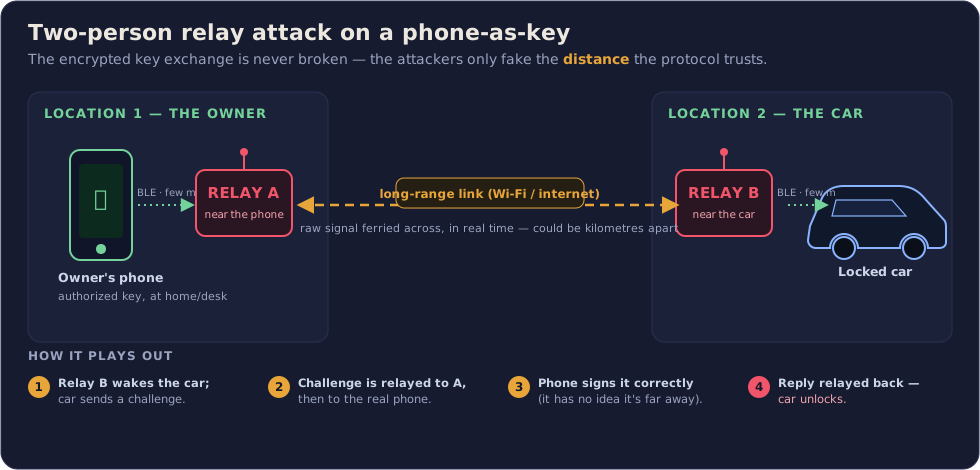
Walked through step by step:
- Relay B stands near the locked car and wakes it. The car issues a cryptographic challenge — “prove you hold the enrolled key.”
- That challenge is carried over a long-range link (Wi-Fi/internet) to Relay A, which is near the owner’s phone — possibly streets or kilometres away.
- The real phone receives the challenge and signs it correctly. It has no way to know it is far from the car; the request looks completely legitimate.
- The signed reply is relayed back to the car, which verifies it perfectly and unlocks. The attackers never saw a key and never broke a cipher — they only extended the distance the protocol assumed was short.
Part C · How the relay is defeated
Section titled “Part C · How the relay is defeated”The fix is not “more cryptography.” It is removing the assumptions the relay abuses, and adding a second independent layer.
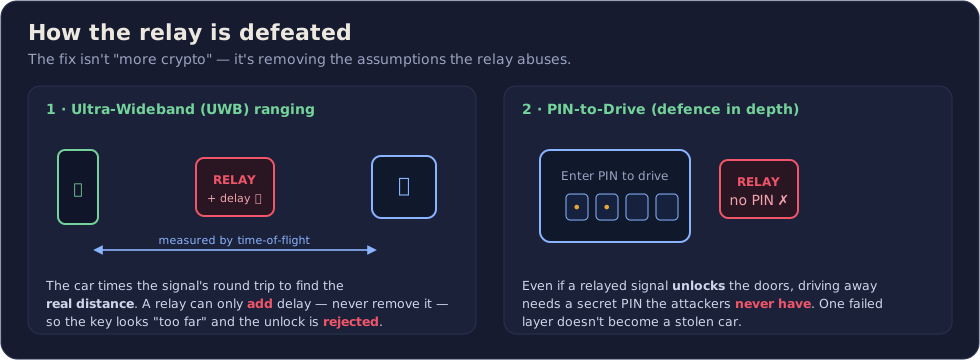
- Ultra-Wideband (UWB) distance bounding. Newer phone-keys measure the signal’s true round-trip time of flight to compute the real distance. A relay can only add delay (it can never make light travel faster), so a relayed key looks “too far” and the unlock is refused. This is the direct, principled counter to a relay.
- PIN-to-Drive (defense in depth). Even if doors are opened, driving away requires a secret PIN the attackers do not have. One bypassed layer does not become a stolen car — the same defense-in-depth principle from the foundations.
- Owner hygiene. Disable passive entry, enable PIN-to-Drive, and keep keys in a signal-blocking pouch.
Debrief
Section titled “Debrief”Bring it back to the map and the course:
- On the Connected Car map, this whole story lives at pin #1 (key-fob / phone-key relay) — now you know exactly how that pin breaks and how it’s closed.
- Compare the effort: passive reconnaissance was trivial; defeating an authenticated system required attacking an assumption, not the crypto.
- Ask the room: what else trusts “it’s nearby” as if it were “it’s authorized”? (Hotel keycards, contactless payments, office badges…)
- The ethical close ties to the post-Mythos world: the people who find flaws like this report them — NCC Group disclosed responsibly, and the defenses above exist because of it. That is the Year of the Defender in practice.